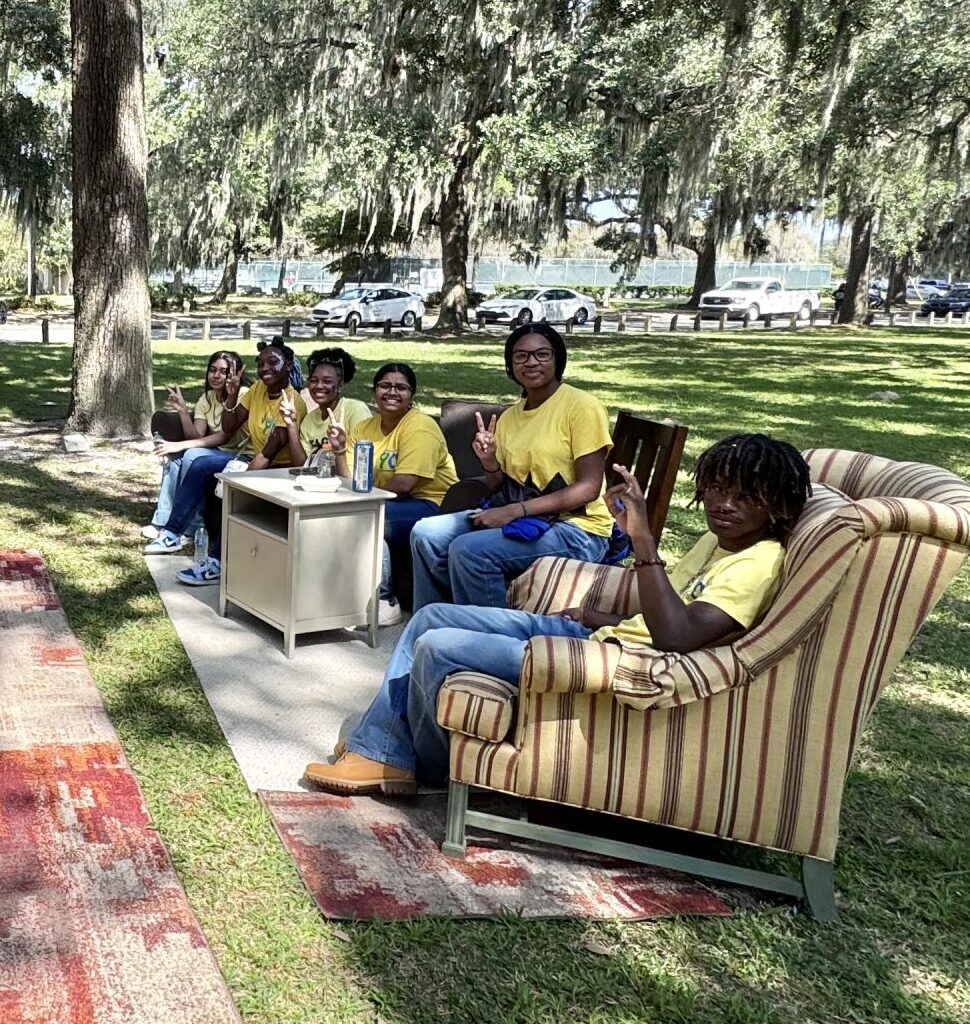
Living Room Conversations in One Word: “Joy”
Fruita For Equality, Fruita, CO
Written October 2024
“It’s a space where, no matter what your opinion is, you can come and feel seen and heard. Because at the end of the day, that’s what we all need as people.”
– McKenzie Kimball, Fruita For Equality
On the second Wednesday of every month inside Lithic Bookstore in Fruita, Colorado you will find folks from throughout the community coming together to participate in a Living Room Conversation.
Conversation topics vary, but what remains constant is the sponsoring of such conversations by the stalwart, grassroots organization, Fruita for Equality.
Fruita for Equality, a nonprofit organization that began in 2020 follows the mission of “promoting and supporting equality, inclusivity, and diversity through meaningful conversations and action in our community.”
Monthly Living Room Conversations wasn’t an initial feature of Fruita for Equality programming, however for the past two years the organization has been hosting conversations and has no intention of stopping anytime soon. After the success of their initial community book read, the organization was looking for recurring offerings to bring to their community. Living Room Conversations appeared to be a perfect addition to their programming.
Belonging was chosen as the topic for the first monthly conversation for multiple reasons. First, because it felt like a less-intimidating and divisive topic to begin with. Second, because of the division experienced in the Fruita community. Historically, Fruita was known for being a conservative, rural farming community. As their outdoor sporting tourism has grown, folks have moved in with different backgrounds and political beliefs causing tension within the small community. McKenzie Kimball, a member of the Fruita for Equality team, explained that with such growing tension and Frutia citizens potentially being ‘at odds with each other’, it’s crucial to begin having these types of conversations. “I was really intrigued to see how people would take [participating in the Belonging conversation and Living Room Conversations generally]. Of the first six people who came to the initial conversation, almost all of them come back every month. They continue to see the value in it.”
Regarding her personal experience with the conversations, Kimball shared,
“I can be a little cynical about the future of our world. If you read the news sometimes it feels like everything’s just ‘on fire’ and these conversations often make me feel better. [They] give me some humanity and empathy. Even if I don’t agree with [others in the conversation] I feel connected to my community. I think everyone felt that off the bat in the first meeting and that’s why people keep coming back even though maybe [one month’s conversation] might not be a topic they’re super interested in. It gives us all a sense of humanity.”
Conversation topics are chosen based upon current events, participant feedback, and other relevant situations.
For one conversation they used LRC’s Homelessness conversation guide. Kimball explained it was an impactful conversation because city council members directly involved in tackling such issues attended the conversation.
Other conversation guides used include Abortion, Holiday Traditions, Police & Community Relations, Race & Ethnicity and others. As of October 2024, 20 conversations have been held.
When asked which conversations were most meaningful to her, Kimball mentioned the Police & Community relations conversation. She explained,
“One of our local [police] officers came who has been policing in the community for about 20 years. I definitely have opinions [on the topic] as a young person who’s lived in a lot of different places. A lot of our members who attend regularly are retired folks who have lived in rural communities for a long time, so I was expecting [going into the conversation] to be the ‘odd ball out’. I was to a degree, but getting to hear from the police officer’s perspective on the change in culture that’s been happening on the [police force] and on the things that are challenging about his job allowed me to come out of the conversation with a more kaleidoscopic view. I gained a lot of nuance that I didn’t expect to. I think a lot of folks walked out of [the conversation] feeling that ‘I wouldn’t have thought about it that way’, and that to me is the point of these [conversations]. Not to change someone’s mind or to come to some conclusion, but for more people to start to feel empathy and see nuance, that everyone has a different place they are coming from.”
When asked what she wished more people knew about Living Room Conversations, Kimball shared, “That they’re actually surprisingly easy!” She continued, “I wish more people had the gumption to do this. Whether it’s with your family, work group, or book club or whatever, because the structure is so laid out. You don’t have to be a facilitator or need to have prepared weeks in advance. You just need to have the time and be present.”
When asked how she would describe Living Room Conversations Kimball said, “It’s a format to help you talk about things that can be challenging and to feel more comfortable knowing that you’ll be able to share your opinion and be heard and respected. Sometimes we need some ground rules to talk about hard things, and these [provide] the ground rules.”
Lastly, when asked why participation in Living Room Conversations is important for her community Kimball reflected, “In a community that feels really divided, which I suppose every community in the US [is] in some way, it’s really important to try to build spaces where people can connect, whatever that looks like.”
From the beginning of the project organizers have made a conscious effort to make every participant feel welcome because as Kimball explained, they hope
“It’s a space where, no matter what your opinion is, you can come and feel seen and heard. Because at the end of the day, that’s what we all need as people. If we did more of that, perhaps there wouldn’t be so much division.” She furthered, “As a young person I feel frustrated with the future and the possibilities, but this is one little way that I can say ‘I’m doing something good’ that is very small scale, but also feels big in the way that, the 45 people who have come to these [conversations] might be more willing to be kind to someone and be empathetic. And that’s really valuable to do. In a world of divisiveness we need spaces where people feel seen and heard and can listen to each other and I think this is really doable.”
To learn more about the Fruita for Equality organization visit https://fruitaforequality.org/
Written by Cassidy Weaver, Living Room Conversations Impact & Evaluation Partner